
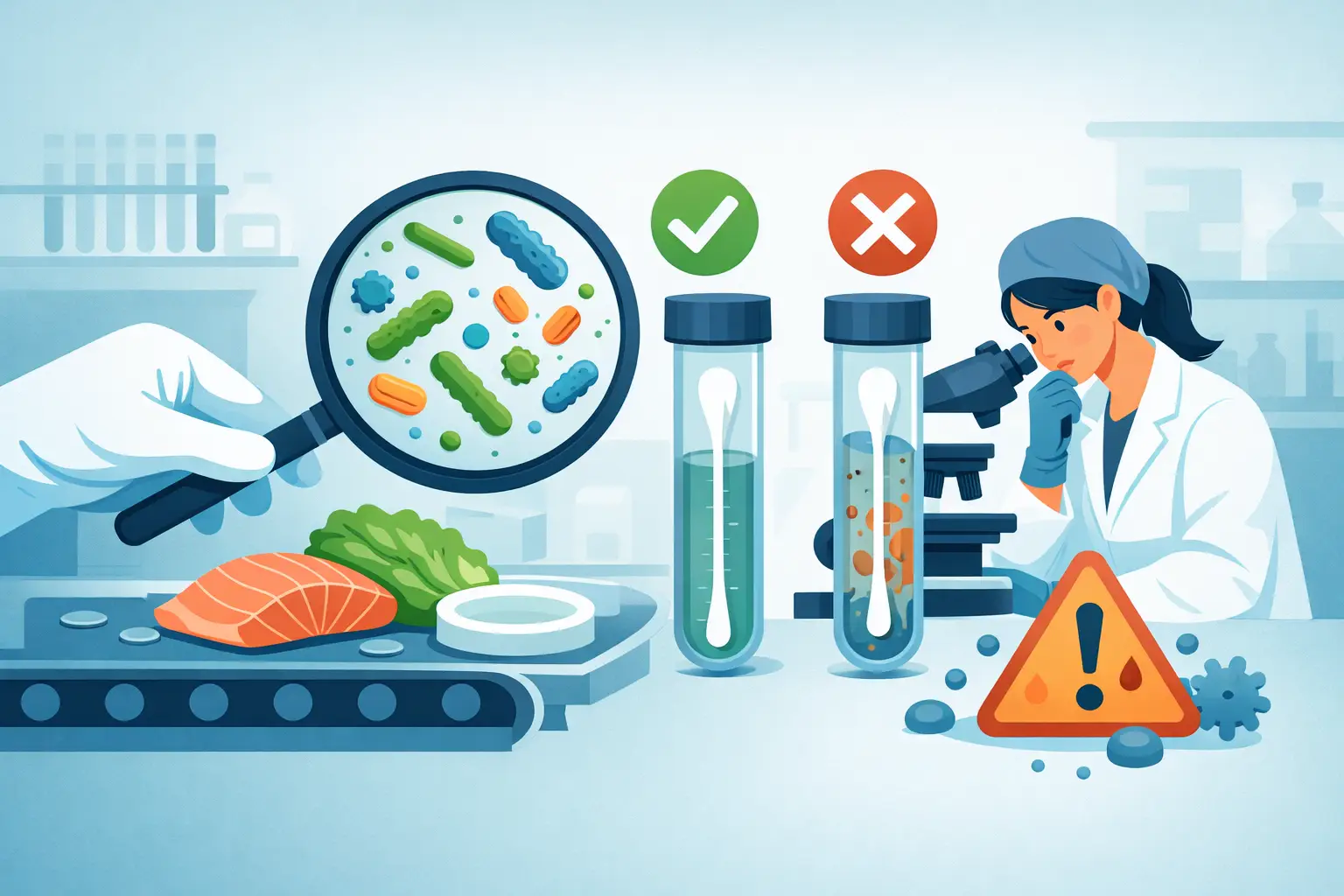
What Causes Failed Hygiene Swabs?
What causes failed hygiene swabs? Learn the main reasons sites fail ATP and microbiological swabs, and how to improve cleaning results.
A hygiene swab fails at exactly the wrong moment – just before start-up, during a customer visit or in the middle of an investigation into shelf life, spoilage or environmental contamination. When teams ask what causes failed hygiene swabs, the answer is rarely a single issue. In most food and dairy sites, failures come from a combination of cleaning method, equipment design, sampling technique, chemical performance and simple timing.
That matters because a failed swab is not just a poor result on paper. It can point to ineffective cleaning, residual product, poor rinse control, harborage points or weaknesses in verification itself. For QA, QC and production teams, the real value lies in understanding whether the swab reflects a genuine hygiene risk, a process control issue or a testing inconsistency.
What causes failed hygiene swabs in practice?
In day-to-day operations, failed hygiene swabs usually fall into three broad categories. The first is genuine surface contamination – food residue, microbial growth or biofilm left behind after cleaning. The second is a process problem, where the cleaning regime is not matched to the soil, line design or production schedule. The third is a verification problem, where the swab result is influenced by poor technique, the wrong test point or testing at the wrong stage.
Those categories often overlap. A conveyor splice may retain product because the equipment is difficult to clean, but the issue only appears when swabbing is carried out consistently in the same niche location. In another case, ATP failures may reflect sanitiser residue or inadequate drying rather than high microbial load. That is why swab failures need interpreting in context, not treated as a standalone pass-fail event.
Residual product is one of the most common causes
In dairy and food production, the simplest explanation is often the correct one. If product remains on a surface after cleaning, a swab is likely to fail. Fats, proteins, sugars and mineral deposits can all interfere with hygiene verification, whether you are using ATP systems, protein swabs or microbiological contact methods.
Dairy plants see this regularly around filler heads, valves, dead legs, gaskets, sample taps and transfer points. Even where a line looks visually clean, microscopic residues may still be present. Once residues remain, they do more than trigger a result – they feed microbial survival and make later cleaning harder.
The cleaning chemistry must match the soil. A regime that works well for one product may underperform with another, especially where there is high fat loading, cooked-on protein or seasonal formulation changes. Concentration, contact time, water temperature and mechanical action all affect whether residue is fully removed.
Inadequate pre-cleaning and rinsing
Pre-rinsing is often underestimated. If gross soil is not removed before detergent is applied, the chemistry is effectively spent fighting bulk contamination rather than cleaning the surface. The result can be patchy removal and persistent hotspots.
Rinsing also matters. If detergent or sanitiser residues remain, they may interfere with some rapid hygiene tests and can mask the true condition of the surface. A low ATP reading does not always mean the surface is microbiologically sound, just as a high reading does not always mean live contamination. The test method and surface condition need to be read together.
Equipment design creates repeat failures
Some failed hygiene swabs are driven less by cleaning effort and more by cleanability. Poorly designed or ageing equipment creates areas where product accumulates and standard cleaning simply does not reach. Hinges, seals, threads, hollow rollers, damaged welds and cracked plastics are familiar examples.
This is where trend data is more useful than isolated failures. If the same site repeatedly fails in the same location, there is a strong chance the problem is structural. Re-cleaning may clear the immediate result, but it will not remove the underlying cause.
For production and engineering teams, this is often the point where hygiene verification becomes a maintenance issue as much as a sanitation issue. Replacing worn components, improving access for inspection or changing a difficult-to-clean part may do more for swab performance than adjusting the detergent dose.
Biofilm and difficult harborage points
Where moisture, nutrients and time come together, biofilm can become a hidden reason for recurrent failure. Once established, biofilm is far more resistant to normal cleaning and sanitising than free contamination on an exposed surface.
Drains, filler environments, shadow areas and wet processing zones are typical risk points. A site may pass for days and then fail again because fragments break away or because cleaning is only disrupting the surface layer. In these cases, repeated swabbing without root cause action tends to produce frustration rather than control.
Poor sampling technique can distort the picture
Not every failed result points directly to poor hygiene. Swabbing technique has a major influence on consistency, particularly where several operators are involved across shifts or departments.
Variation can come from swabbing a different sized area, applying inconsistent pressure, missing the highest-risk spot or taking the sample before the surface condition has stabilised. If one operator swabs aggressively into joints and crevices and another takes a light pass over the open face of the same asset, the numbers will not be comparable.
That does not mean the result is invalid. It means the site needs a standardised method for where, when and how the swab is taken. Without that, trend analysis becomes unreliable and investigations take longer than they should.
Timing makes a difference
Timing is one of the most overlooked answers to what causes failed hygiene swabs. A swab taken immediately after sanitising may behave differently from one taken after the recommended dwell period, after final rinse or after the surface has dried. Similarly, an environmental swab taken mid-production will tell a different story from one taken post-clean.
The right timing depends on what the site is trying to verify. If the goal is cleaning validation, then the sample point should reflect the end state of the cleaning process. If the goal is operational hygiene monitoring, then in-process checks may be more useful. Problems arise when sites mix those purposes and compare unlike results.
The wrong test for the wrong question
ATP swabs, protein swabs and microbiological swabs are not interchangeable. Each answers a different question, and failed hygiene swabs sometimes occur because the chosen method does not fit the risk being assessed.
ATP is valuable for rapid indication of organic residue, but it is not a direct microbial count. Protein swabs are useful where allergen or product residue is the concern, but they do not replace microbiological monitoring. Culture-based methods provide stronger evidence of viable organisms, but they are slower and need careful interpretation.
In practical terms, a site can pass ATP and still have a microbiological issue if the contamination source is niche, established or protected. Equally, a marginal ATP result may reflect harmless residue after a changeover rather than a significant hygiene failure. The best programmes use the method that matches the control point, not the one that is merely quickest.
Human factors and production pressure
Many swab failures come back to routine operational pressure. Cleaning windows get shortened, disassembly is reduced, tools are missing, chemical drums run low or training becomes inconsistent across shifts. None of these issues is unusual, but together they create exactly the conditions in which failures appear.
This is especially relevant in high-throughput sites, where hygiene teams are expected to turn around equipment quickly for the next production run. If schedules are tight, there is a tendency to focus on visible cleanliness and line release rather than on hidden or historical fail points.
That is why failed swabs should not be treated simply as operator error. More often they reveal a mismatch between expected hygiene outcomes and the time, access, equipment condition or testing discipline available on site.
How to reduce failed hygiene swabs
The most effective response is not to swab more often without purpose. It is to make the verification system more precise. Start by identifying whether failures cluster by asset, shift, product, operator or cleaning regime. A pattern usually emerges quite quickly.
Then review the basics – cleaning chemistry, dosage control, contact time, rinse quality, dismantling standards, equipment condition and swab method. If failures are repeated in niche locations, consider whether the issue is cleanability rather than execution. If results vary widely between operators, standardisation and retraining are usually more valuable than changing the acceptance limit.
For sites under regular audit pressure, it is also worth checking whether pass-fail thresholds still reflect the equipment, product type and test method in use. Limits that are too loose are a compliance risk. Limits that are too tight, without technical justification, can create noise rather than control.
Where teams need more confidence in day-to-day verification, working with a specialist supplier such as Labtek Services can help align the swab format, monitoring products and test approach to the actual process environment rather than relying on a generic hygiene routine.
Failed hygiene swabs are most useful when they are treated as evidence, not annoyance. They show where the process is not yet under full control – and that is exactly the point where better decisions start.
