
A Practical Guide to Peroxide Test Strips
A practical guide to peroxide test strips for food and dairy QC: selecting ranges, sampling correctly, reading results and documenting checks confidence.
Peroxide residues are rarely a complicated problem until a line is ready for production, a rinse check is unclear, or an auditor asks how sanitiser carryover is controlled. This guide to peroxide test strips is intended for dairy and food quality teams that need a practical, defensible way to verify hydrogen peroxide levels in process water, final rinses, equipment and selected products.
Test strips provide a fast screening result at the point of use. They are not a substitute for a validated laboratory method where a precise concentration, formal release result or investigation demands one. Used within their stated range and with a controlled sampling routine, however, they are a valuable part of day-to-day hygiene verification.
What peroxide test strips measure
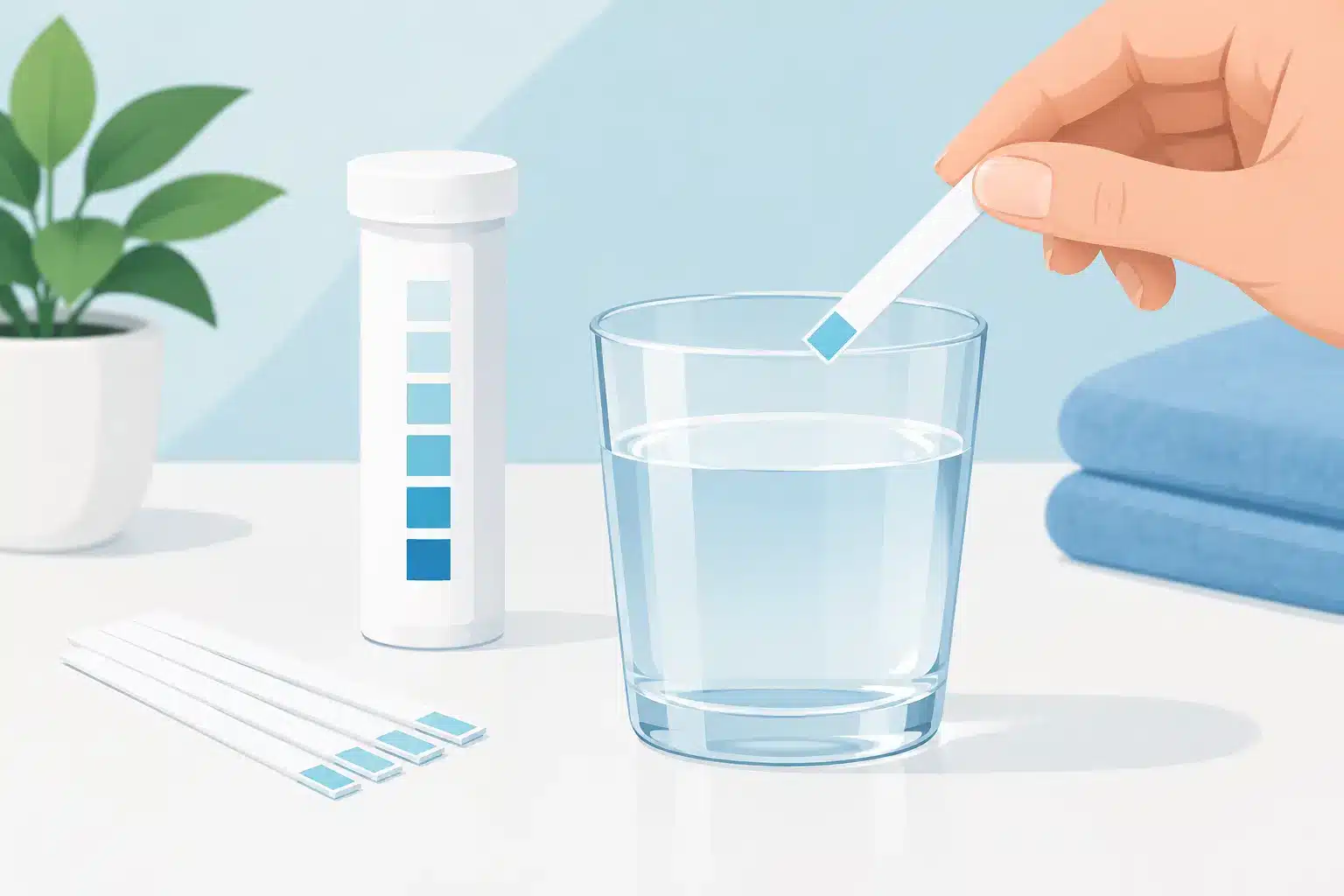
Most peroxide test strips are designed to detect hydrogen peroxide, usually expressed as mg/L or ppm in aqueous samples. The reactive pad changes colour when it contacts peroxide; the result is then compared with the manufacturer’s colour scale after a defined development time.
For food and dairy operations, the usual purpose is to confirm whether peroxide remains after cleaning and sanitising, or whether a peroxide-based disinfectant has reached the expected working strength. The same principle can support checks in water treatment, beverage processing, hospitality hygiene and agricultural applications.
The result is generally semi-quantitative. A strip may distinguish between, for example, zero, low residual levels and a higher concentration band, but it cannot offer the analytical precision of a titration, photometric method or validated instrumental assay. That distinction matters when setting acceptance criteria. A strip is well suited to routine confirmation that a final rinse is clear of detectable peroxide within the test range. It is less suitable for certifying an exact concentration close to a regulatory or customer specification limit.
Where peroxide strip testing adds value
The strongest use case is routine process control. A production or hygiene team can test final-rinse water before product contact, verify the concentration of a freshly prepared sanitising solution, or investigate a suspected carryover issue without waiting for a laboratory result.
In dairy processing, residual chemical control is particularly significant around CIP systems, fillers, tanks, pipework and surfaces that come into contact with milk, cream, yoghurt or cheese. A rapid check can help prevent avoidable product holds, off-flavours, chemical contamination concerns and rework. It also gives the QA team an objective record that a specified check was performed.
The correct testing point depends on the process risk assessment. Final-rinse samples taken from the point of use are usually more meaningful than a sample collected from a central return line. The latter may indicate that rinsing is broadly progressing, while the former shows what the equipment is actually receiving immediately before production starts.
Selecting peroxide test strips for the application
Match the range to the decision you need to make
The most common purchasing error is selecting a range that is too broad for residual testing. If the objective is to establish that rinse water contains little or no peroxide, a low-range strip with fine colour increments is normally more useful than one intended for checking concentrated disinfectant.
Conversely, a low-range strip can saturate immediately when used to verify a prepared sanitiser solution. In that case, a higher-range strip or a dilution procedure approved by the strip manufacturer may be appropriate. Always ensure that the result can be interpreted against your site limit rather than simply producing a colour change.
Consider whether the strip’s scale is in ppm, mg/L or percentage. For dilute aqueous solutions, 1 mg/L is broadly equivalent to 1 ppm, but this should not be assumed for every matrix or product formulation. Document the unit used in the procedure and on the record sheet.
Consider the sample matrix and possible interferences
Clear water samples are generally the simplest. Process samples can be more challenging. Colour, turbidity, high alkalinity or acidity, oxidising chemicals other than hydrogen peroxide, and some cleaning components may affect the reaction or make the colour comparison difficult.
If the sample is from a food product, a rinse containing detergent, or a complex process stream, check the manufacturer’s instructions for known interferences and validated sample conditions. Where the matrix is not covered, conduct a small site assessment using a known blank and, where suitable, samples spiked with a known peroxide concentration. This gives evidence that the strip is fit for the intended check.
Buy for controlled routine use, not occasional convenience
Strip performance relies on correct storage and intact packaging. Choose pack sizes that can be used within the stated shelf life after opening. In a busy site, it may be preferable to hold smaller, regularly replenished packs rather than a large container that is repeatedly opened over many months.
Keep strips dry, tightly closed and protected from heat, direct light and contamination. A container left beside a wash-down area or open on a wet bench can become unreliable long before its printed expiry date.
How to use peroxide test strips correctly
The manufacturer’s instructions always take priority because immersion time, reaction time and colour scale vary by product. A controlled routine usually follows the same practical sequence.
First, take a representative sample in a clean container. Flush the sampling point where appropriate, particularly for final-rinse checks, so that stagnant liquid does not distort the result. Avoid using containers that have held cleaning chemicals unless they have been properly rinsed and verified as clean.
Remove one strip without touching the reactive pad. Immerse it for the specified time, remove excess liquid as instructed, and start timing immediately. Read the colour at the stated reaction time, in good neutral light. Reading too early may understate the result; reading after the permitted time can produce a false or ambiguous result.
Compare the pad against the supplied scale while it is still in its valid read window. Record the nearest colour band rather than trying to infer an unsupported decimal value. If the colour lies between two blocks, your procedure should state whether to record the higher value, repeat the test, or treat the result as a trigger for further investigation.
Do not return unused strips to an open bench container, reuse a strip, or interpret a result after the scale has faded. These simple controls are often more influential than the nominal sensitivity printed on the pack.
Setting acceptance criteria for rinse and sanitiser checks
A useful acceptance criterion answers a practical question: can this line proceed, must it be rinsed further, or does the chemical solution require adjustment? It should be based on your cleaning programme, chemical supplier guidance, equipment requirements, HACCP plan and any applicable customer or regulatory requirements.
For a final rinse, the criterion may be no detectable peroxide at the strip’s lowest reportable level, or below a defined site limit. For a prepared sanitising solution, the criterion may be a concentration band that confirms correct dosing. These are different controls and should not share a vague instruction such as “test for peroxide”.
Where a result exceeds the limit, the response should be equally clear. Typical actions include extending the rinse, checking CIP sequence and valve operation, verifying chemical dosing, retesting at the point of use and escalating repeated failures to engineering or technical management. A one-off failed strip result should not automatically be dismissed as operator error, but neither should it be treated as proof of a process failure without checking sampling and strip handling.
Recording results that stand up to review
A strip result becomes more valuable when it is traceable. The record should identify the date and time, line or sampling point, sample type, strip range or product reference, lot number and expiry date, operator, result, acceptance limit and action taken where relevant.
For critical checks, record the cleaning cycle or batch reference as well. This allows a trend to be identified if residual peroxide repeatedly appears after a particular programme, on one filler, or after a change in chemical concentration. It also supports root-cause work when production, quality and hygiene teams need to review the same event.
Training should cover colour interpretation, timing, storage and the difference between a screening check and a validated analytical result. Retained training records and periodic competency checks are proportionate controls in sites where strip results form part of pre-operational release.
When a strip result needs confirmation
Escalate to a more quantitative method when the result is close to a critical limit, unusual for the process, disputed, or likely to affect product disposition. Confirmation is also sensible when the sample is coloured or chemically complex, when a customer specification requires a numerical result, or when an investigation may lead to corrective action beyond a routine re-rinse.
Labtek Services can assist professional users in selecting testing consumables that suit the concentration range and working environment, particularly where peroxide checks form part of a wider dairy or food QC programme. The most effective strip is not necessarily the most sensitive one – it is the one that gives a clear, repeatable answer to the operational decision in front of the team.
