
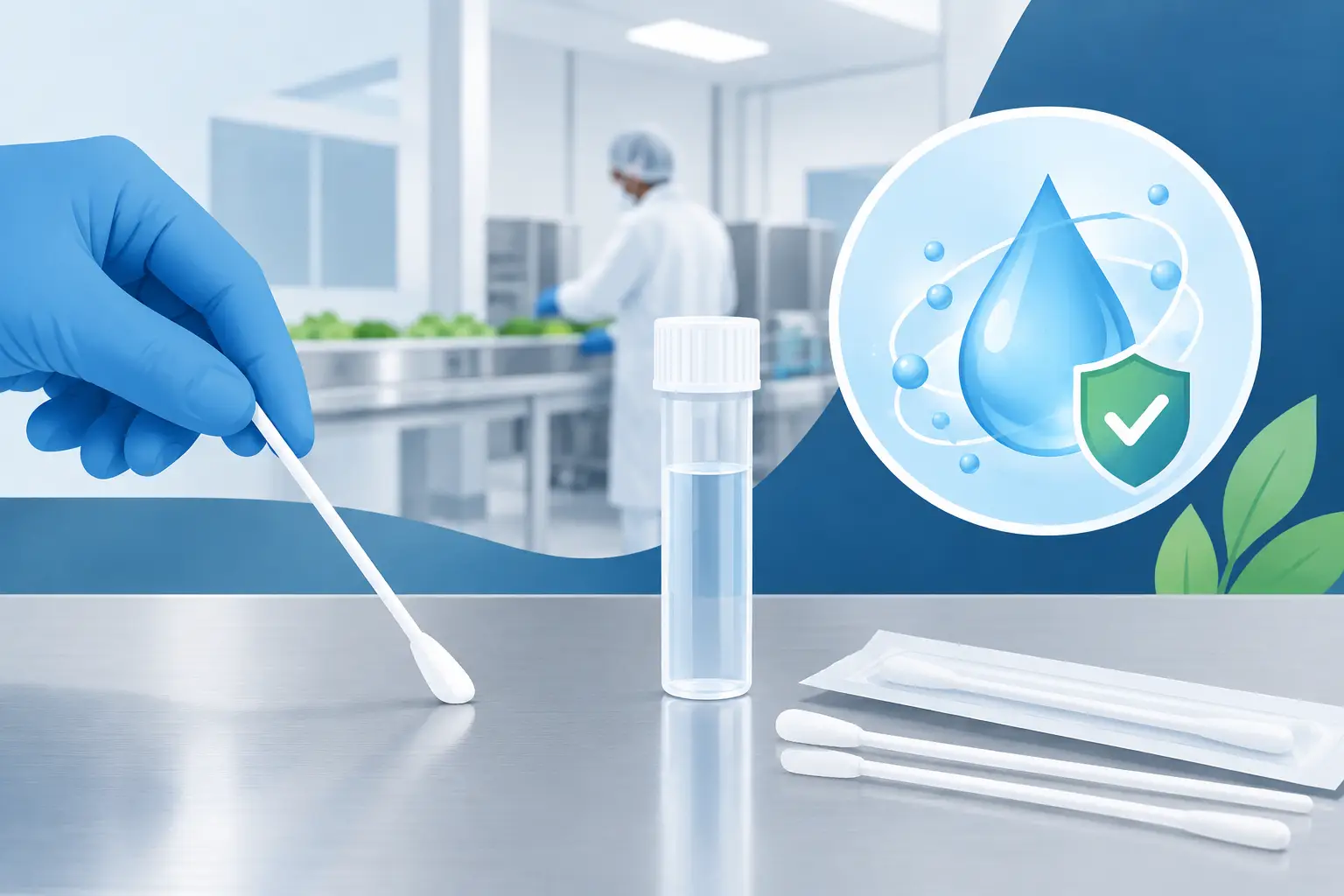
ATP Rinse Water Swabs for Hygiene Control
ATP rinse water swabs help food and dairy sites verify CIP rinse water, investigate hygiene risks and support confident corrective action daily.
A final rinse can look perfectly clear while still carrying organic residues that deserve investigation. ATP rinse water swabs give food and dairy teams a rapid way to assess that rinse water, providing a measurable indication of biological residue before a line is released, investigated or re-cleaned.
For sites operating CIP systems, this is not a replacement for a validated cleaning regime, chemical concentration checks or microbiological verification. It is a fast, practical screening tool that can help QA, production and engineering teams make better decisions when time and product risk are both pressing.
What ATP rinse water swabs measure
ATP, or adenosine triphosphate, is an energy-carrying molecule found in living cells and in residues from food, microorganisms and other organic material. When a rinse water sample is collected with a compatible ATP sampling device and read in a luminometer, the reaction produces light. The instrument reports the result as relative light units, usually shortened to RLU.
A higher RLU result indicates more ATP is present in the sample. In practical terms, that can point to residual product, biofilm disturbance, ineffective cleaning, poor rinsing or contamination entering the system after cleaning. It does not identify the organism involved, prove that a pathogen is present or provide a microbiological count. That distinction matters when interpreting any failure.
The term “swab” is often used broadly, but rinse-water testing normally requires a water-sampling device rather than a conventional surface swab. The device must be designed for liquid samples and compatible with the site’s luminometer. Product, instrument and sampling method should always be matched, as results from different ATP systems are not directly comparable.
Where ATP rinse water testing adds value
In dairy processing, rinse water testing can be especially useful after CIP of tanks, pipelines, fillers, valves and associated process equipment. Milk proteins, fats and sugars can remain in difficult-to-clean areas even where the final rinse appears visually satisfactory. A rapid ATP result can provide an early warning that cleaning performance has changed.
The same principle applies across food manufacturing. Sites may use ATP rinse water swabs to check final rinses from closed process systems, investigate a recurring hygiene issue, compare cleaning performance between shifts, or confirm the effectiveness of a corrective action after maintenance. Brewing, distilling and beverage operations may also use liquid ATP sampling where product residues and water quality have a direct bearing on hygiene control.
The greatest value comes from trend information rather than a single isolated reading. A result that is within an established limit may still warrant attention if it is significantly higher than the normal baseline for that line. Conversely, one unexpected high result should be assessed alongside the cleaning record, sampling point, process conditions and repeat sample before drawing conclusions.
Establish limits that reflect the process
There is no universal pass or fail RLU value for rinse water. Limits depend on the ATP system, the sample volume, the nature of the product, the complexity of the equipment and the site’s hygiene risk assessment. A rinse from a high-fat dairy process will not necessarily behave like a rinse from a low-residue beverage line.
A sensible approach is to collect results from known satisfactory cleans over an agreed period. These baseline data can then be used to establish site-specific acceptable, caution and action limits. The limits should be documented within the hygiene monitoring programme and reviewed when there are material changes to product, chemistry, water supply, CIP parameters or equipment design.
It is also good practice to define what happens at each level. A caution result may trigger a repeat test and review of CIP records. An action result may require the line to remain out of service, further cleaning, inspection, escalation to technical management or microbiological follow-up. Clear instructions prevent inconsistent responses between shifts.
Sampling consistency is essential
ATP results are only useful when sampling is controlled. Take samples from the same defined point, using the same volume and timing within the CIP sequence. If one operator samples immediately at the final rinse and another samples after water has stood in a hose or drain leg, the data may not be comparable.
Before introducing routine monitoring, confirm the following controls:
- the sampling device is intended for water or rinse-water applications;
- the luminometer is the correct model and is maintained in line with the manufacturer’s instructions;
- operators are trained in aseptic collection, activation and reading procedures;
- sample points, volumes, limits and corrective actions are recorded in the hygiene plan.
Particular care is needed where sanitisers, detergents or other chemicals may remain in the sample. These can affect the ATP reaction or indicate that the rinse is incomplete. If chemical carry-over is likely, follow the test manufacturer’s guidance and investigate whether a later sampling point or additional rinsing step is more appropriate.
A practical routine for CIP verification
The most effective programmes make rinse-water ATP testing part of a defined verification routine rather than an occasional response to a problem. The sampling point should be selected according to risk. A return line, final rinse outlet or point downstream of a difficult-to-clean circuit may provide more meaningful information than a convenient tap.
Collect the specified volume without contaminating the device, activate it as instructed and read it promptly in the luminometer. Record the line or asset, date, time, operator, product run, cleaning cycle reference and RLU result. Where results are outside the expected range, retain the associated CIP data such as time, temperature, flow, concentration and conductivity where available.
The immediate response should be proportionate. Re-test when sampling error is possible, but do not use repeated testing simply to obtain a more acceptable result. If a repeat confirms an elevated reading, investigate the cleaning cycle and equipment condition. Common causes include depleted or incorrectly dosed chemistry, inadequate temperature or contact time, poor flow, blocked spray devices, worn seals, dead legs, poor drainability and residual product in valves or hoses.
After corrective cleaning or repair, a further ATP rinse-water test can show whether the action has returned the result to the established baseline. Where the risk or result justifies it, microbiological sampling may be the next step. ATP monitoring is rapid verification; microbiology remains necessary when organism-specific information or formal product-risk investigation is required.
Avoid over-interpreting a result
ATP testing is highly useful, but it has limits. It detects organic material rather than only viable microorganisms. A high result may reflect food residue, non-viable cells or contamination from the sampling process. A low result does not by itself demonstrate the absence of all microbiological hazards.
For this reason, ATP rinse water results should sit alongside visual inspection, CIP parameter review, chemical verification, environmental monitoring and periodic microbiological testing. In an audited food safety system, the strength of the programme lies in how these controls support one another.
Instrument performance also needs attention. Luminometers should be checked and maintained according to the manufacturer’s schedule, with appropriate control materials where specified. Store sampling devices within their stated conditions and observe expiry dates. These routine details are easily overlooked, yet they protect the reliability and traceability of the data used to support hygiene decisions.
Choosing the right product and support
When specifying ATP rinse water swabs, confirm whether the device is designed for liquid sampling, which luminometer it requires and the sample volume it accommodates. Procurement decisions should also consider batch consistency, storage requirements, lead times and the availability of technical advice when a site is setting limits or investigating unusual trends.
For dairy and food manufacturers, the right choice is rarely just the lowest-cost consumable. A compatible, consistently supplied system supported by a documented method can reduce uncertainty during production changeovers, hygiene verification and customer or third-party audits. Labtek Services supports laboratories and quality teams with specialist hygiene monitoring consumables and practical product guidance for regulated production environments.
Used consistently, ATP rinse-water testing turns the final rinse from an assumption into evidence. That evidence is most valuable when it prompts timely questions about cleaning performance, protects product quality and helps the site act before a minor deviation becomes a recurring hygiene problem.
