
Choosing an ATP Hygiene Monitoring System
Learn how to choose an ATP hygiene monitoring system for food and dairy sites, with practical advice on sensitivity, swabs, data and workflow fit.
If a hygiene result arrives too late to prevent a problem, it has limited value. That is why an ATP hygiene monitoring system has become a standard tool across food production, dairy processing and high-care environments. It gives teams a fast, practical way to verify cleaning effectiveness between production runs, before start-up, or as part of routine environmental monitoring.
For technical managers and QA teams, the appeal is straightforward. ATP testing does not replace microbiology, allergen validation or visual inspection, but it does give an immediate indication of organic residue on a surface. Used properly, it helps identify where cleaning controls are drifting, where retraining is needed, and where a process that looks acceptable may still leave behind contamination risk.
What an ATP hygiene monitoring system actually measures
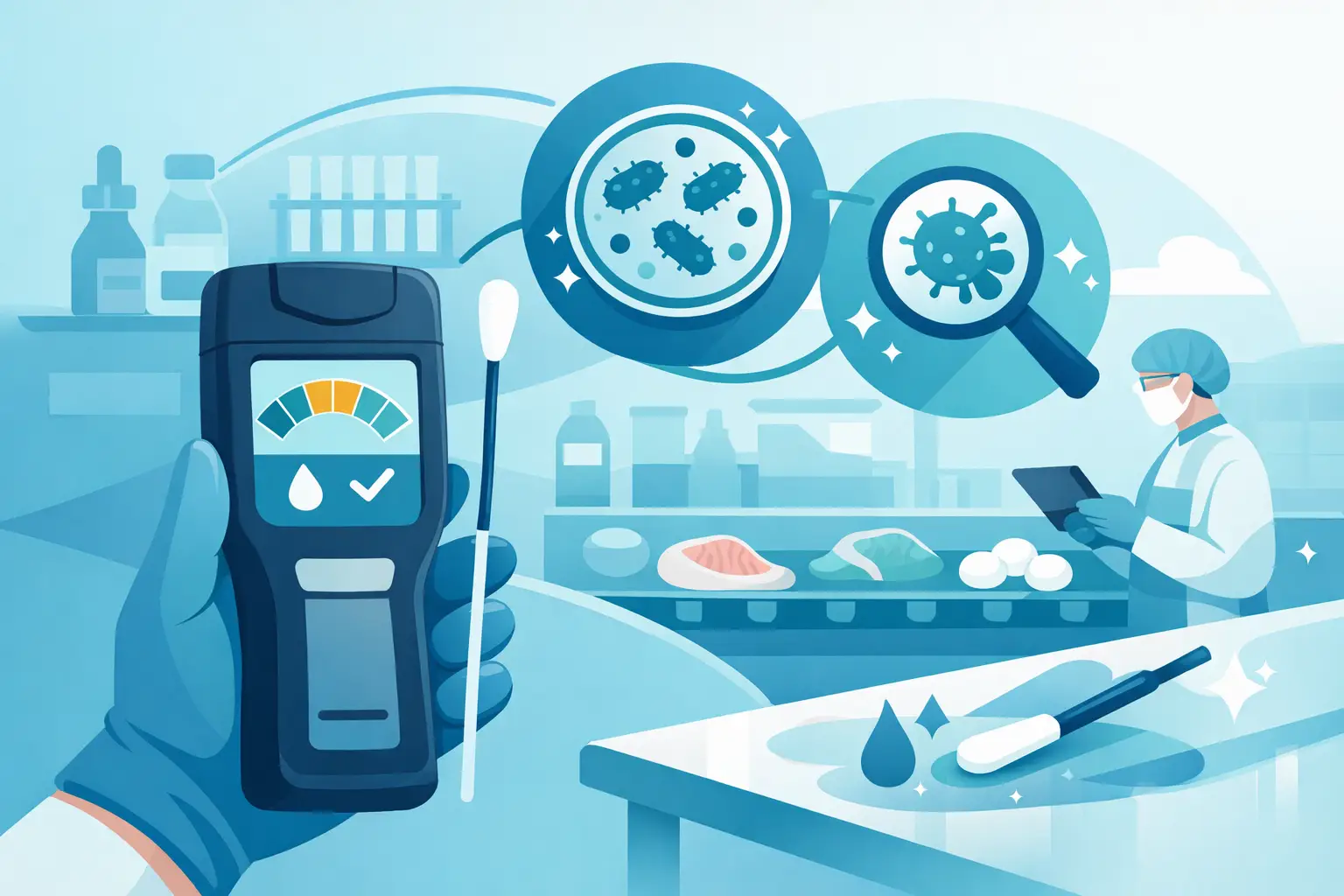
ATP stands for adenosine triphosphate, an energy-carrying molecule present in living cells and organic material. In hygiene monitoring, a swab is used to collect residue from a surface, and the instrument measures the light produced through a bioluminescence reaction. The result is typically displayed in relative light units, or RLUs.
That sounds simple, but interpretation matters. A high reading does not tell you exactly what the residue is, and a low reading does not prove sterility. What it does provide is a rapid indication of whether a surface is acceptably clean according to the threshold your site has established. In regulated food environments, that speed is often the difference between correcting an issue immediately and discovering it only after production has resumed.
Why ATP hygiene monitoring systems matter in food and dairy sites
In dairy and wider food manufacturing, production schedules are tight and hygiene failures are expensive. Delays, product hold, re-cleaning, investigation time and audit pressure all carry a cost. An ATP hygiene monitoring system supports a more controlled response because it gives objective data at the point of use rather than relying only on visual checks or delayed lab results.
This is especially relevant in dairy plants, where protein and fat residues can remain on equipment surfaces, filler heads, pipework exteriors and hard-to-access production areas. Cleaning may appear satisfactory, yet residue can still be present in sufficient quantity to indicate a poor hygienic outcome. ATP testing helps verify whether the clean is genuinely effective before the next batch starts.
There is also a practical audit benefit. Sites that can show a defined hygiene verification programme, with documented limits, trend data and corrective action, are in a stronger position during customer audits and third-party assessments. ATP is not the whole programme, but it is often one of the clearest operational controls to demonstrate.
Where ATP fits – and where it does not
One common mistake is treating ATP as a universal answer. It is useful, but it has limits.
ATP testing is well suited to routine hygiene verification on food contact and non-food contact surfaces, hand hygiene checks in some settings, and rapid confirmation after cleaning. It is less useful if the question is specifically about pathogen presence, allergen residue at a validated level, or microbial identification. Those require other methods.
The best approach is to see ATP as one part of a wider hygiene assurance framework. Visual inspection identifies obvious failures. ATP checks whether organic residue remains. Microbiological testing confirms whether cleaning and disinfection controls are adequate over time. If these methods disagree, that is often where the most useful investigation starts.
How to choose an ATP hygiene monitoring system
For most buyers, selection comes down to more than the meter itself. The right system is the one your team can use consistently, with swabs that fit your application and software that supports the level of control your site needs.
Sensitivity and consistency
Not every production area needs the same level of sensitivity. A high-care dairy filling line may justify tighter control than a low-risk utility area. What matters is that the system gives repeatable readings and supports realistic, validated pass, caution and fail limits for each area.
An instrument with unreliable variation creates unnecessary noise. Too many false failures slow production and undermine confidence in the method. Too little sensitivity can mask poor cleaning performance. In practice, consistency matters just as much as headline sensitivity.
Swab design and sample suitability
Swab chemistry and design have a direct effect on usability. Some are intended for flat surfaces, others for irregular equipment parts, drains or hard-to-reach points. Shelf life, storage conditions and operator handling also affect performance.
This is particularly important on busy production sites where sampling may be carried out by different team members across shifts. If the swab is awkward to use or too fragile for the task, variability increases. A system only works when routine use is realistic under plant conditions.
Speed of results and workflow fit
Fast results are one of ATP testing’s main advantages, but speed has to fit the workflow. A system that produces a reading in seconds is useful only if the instrument is available where the team needs it and the process around retesting, release and corrective action is clear.
Consider who will carry out the test, where the meter will be stored, how samples are labelled, and what happens when a result fails. The practical details decide whether the system becomes an everyday control tool or a piece of equipment used only when an audit is due.
Data handling and traceability
For some sites, a simple handheld meter with local result storage is enough. For larger operations, especially multi-line or multi-site businesses, data handling becomes more important. You may need user-specific logins, trend analysis, location mapping, exportable records and clear audit trails.
That is where procurement decisions often shift from buying a device to choosing a managed system. If results are going to be used for trending, CAPA evidence or customer reporting, the software and record structure deserve as much scrutiny as the luminometer itself.
Setting limits that are realistic
A technically sound ATP hygiene monitoring system can still deliver poor value if the site sets unsuitable limits. There is no universal pass mark that works across all plants and all surfaces.
Limits should be based on your process, your equipment, your cleaning method and your risk profile. Stainless steel tables, conveyor components, gaskets, filler nozzles and external framework will not all behave the same way. Nor will a raw area and a post-pasteurisation environment.
The sensible route is to baseline properly. Test cleaned surfaces repeatedly over time, identify normal variation, compare results with visual and microbiological findings, and then define action levels that are meaningful. This takes more effort at the start, but it avoids the far more common problem of limits being copied from another site and then ignored because they do not reflect operational reality.
Training is part of the system
Even a well-specified instrument can produce weak data if operators sample inconsistently. Swabbing pressure, area size, timing after cleaning, and handling of the device all influence results.
That is why implementation should include a simple sampling protocol with defined points, standardised technique and clear escalation steps. Teams do not need lengthy theory sessions, but they do need to understand what ATP does and does not show. When operators understand the reason behind the test, compliance is usually much better.
Refresher training also matters. If failed results are repeatedly explained away as swabbing error, confidence falls quickly. A better approach is to review trends, investigate recurring failures and use the data to improve both cleaning practice and testing discipline.
Common buying mistakes
The first mistake is focusing only on instrument price. Consumable costs, meter durability, software access, calibration support and replacement lead times all affect total cost of ownership.
The second is buying a system that is too complex for the site. Advanced data capability is useful, but not if everyday users avoid the equipment because the process feels cumbersome. Equally, a very basic system may become limiting if your audit or reporting requirements are expanding.
The third is failing to think about support. Hygiene monitoring equipment sits close to compliance activity, so downtime and uncertainty are not minor issues. Access to technical advice, product guidance and after-sales support can make a noticeable difference, particularly during rollout or when reviewing failed trends.
For that reason, many buyers prefer to work with a specialist supplier that understands both the instrument and the production environment around it. In dairy and food manufacturing, that practical knowledge often matters as much as the specification sheet.
Making ATP part of a stronger hygiene programme
An ATP hygiene monitoring system works best when it becomes routine rather than exceptional. Used consistently, it sharpens cleaning verification, supports investigations, and gives QA and production teams a shared reference point for hygiene decisions.
The value is not in generating more numbers. It is in getting fast, credible evidence that helps the site decide whether equipment is ready, whether cleaning has been effective, and where attention is needed before a minor hygiene issue becomes a production problem. If you choose a system that fits your process, your people and your reporting needs, it becomes a practical control measure rather than another piece of kit on the shelf.
A good system should make hygiene decisions easier, not more complicated – and that is usually the clearest sign you have chosen well.
